Best Way to Take Money Abroad: A UK Traveller's Complete Guide
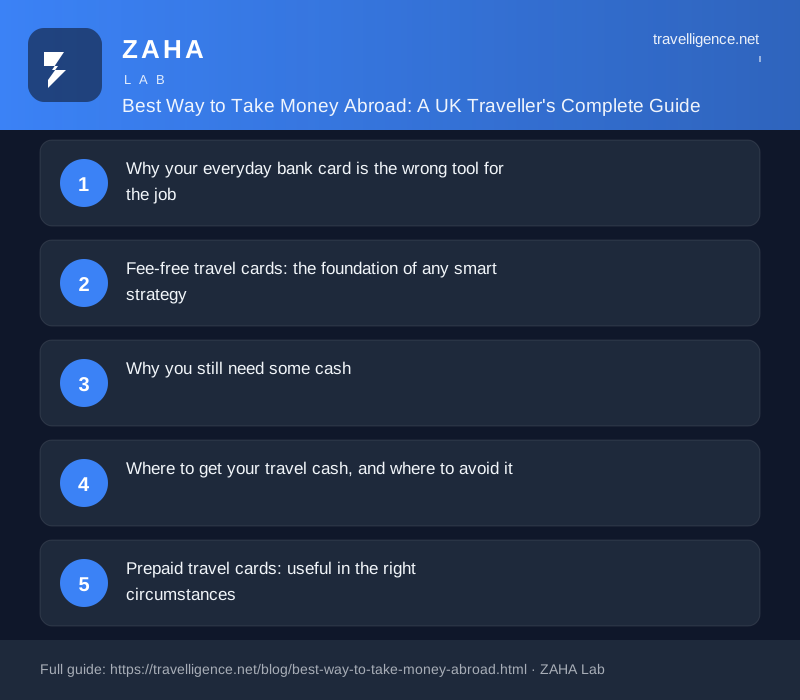
Changing money at an airport almost always costs more than any other option, sometimes dramatically so. The best way to take money abroad is to combine a fee-free travel card for everyday spending with a modest amount of local cash for places that don't accept cards.
Whether you're heading to a European city for a long weekend or embarking on a long-haul adventure, how you manage your travel money will affect how much of it you actually keep. Here's how to approach it without handing over more than you have to.
Why your everyday bank card is the wrong tool for the job
Most standard UK current account debit cards and mainstream credit cards charge fees when you use them overseas. These typically come in two forms: a foreign transaction fee applied as a percentage of every purchase, and a cash withdrawal fee on top of any interest when you take money out of an ATM.
Some cards also apply a worse-than-necessary exchange rate on top of the official network rate. These charges rarely appear as a single, obvious line on your statement, they tend to quietly erode each transaction, making it easy to return from holiday wondering where the money went.
The answer is not to abandon cards altogether. It's to use the right one.
Fee-free travel cards: the foundation of any smart strategy
A fee-free travel card, either a debit card linked to a specialist account or a credit card designed for overseas use, is the most effective single tool available to a UK traveller. These products are built specifically to let you spend in foreign currencies without charging a foreign transaction fee, and the best of them also waive ATM withdrawal fees abroad, at least up to a monthly limit.
When looking for a travel-friendly card, focus on these factors:
- No foreign transaction fees on purchases abroad
- No or low ATM withdrawal fees overseas (check whether there's a monthly free limit)
- Exchange rates based on Mastercard or Visa network rates, with no additional markup
- An app that lets you freeze the card instantly if it's lost
- No annual fee, or a fee that makes sense given what you'll actually use
Use a comparison website to find current options, the market changes regularly and what's available to you will depend on your credit history and circumstances. Search for "fee-free travel debit card UK" or "best overseas credit card no fees" to find up-to-date comparisons, and read the terms carefully rather than relying on headline claims.
If you choose a travel credit card, pay it off in full each month. Otherwise, the interest will cancel out any savings on fees.
Why you still need some cash
Even in an increasingly cashless world, foreign currency remains essential in many situations. Street food vendors, local markets, small family restaurants, rural taxis, tipping, and some public transport systems operate on a cash-only basis. In parts of southern and eastern Europe, much of South-East Asia, and across Africa and Latin America, cash is far more widely used than travel guides sometimes suggest.
The question is not whether to bring cash, it's how much, and how to get it cheaply.
A sensible approach is to arrive with enough to cover your first day or two: transport from the airport, an initial meal, and any immediate incidentals. Beyond that, withdrawing cash as you need it from local ATMs using your fee-free card is almost always more cost-effective than carrying a large sum from home, where the exchange rate may not be as favourable.
Where to get your travel cash, and where to avoid it
Not all currency exchange is equal, and the gap between the best and worst options can be considerable. Here is a rough guide from worst to best:
Airport bureaux de change. These are consistently among the worst places to exchange money, at both UK departures and overseas arrivals. They rely on travellers being time-pressured or simply unprepared. Avoid them if you can.
Hotel exchange desks and tourist-area booths. The same logic applies. High footfall, low competition, and little incentive to offer a fair rate. If you see a sign advertising "0% commission", look carefully at the exchange rate itself, the margin is almost always built in there instead.
High-street bureaux de change. More competitive, but rates still vary between providers. Always compare the total amount of foreign currency you'll receive for a fixed amount of sterling, rather than looking at the headline rate alone. Fees and commissions are sometimes charged separately and can make a seemingly good rate look worse in practice.
Online currency exchange, ordered in advance. For cash, ordering currency through an online service and having it delivered to your home, or collecting at a designated location, often produces the best rates. You'll typically need to order several days in advance, so plan ahead. Factor in any delivery or collection charges before assuming it's the best deal.
Prepaid travel cards: useful in the right circumstances
Prepaid travel cards sit somewhere between cash and a fee-free debit card. You load them with foreign currency at the rate available on the day you top up, then spend from that balance while you're away.
Their appeal is predictability: you know exactly how much you've loaded, which makes budgeting straightforward. Some travellers also prefer that a prepaid card isn't directly connected to their main bank account, limiting the damage if the card is compromised.
But there are real drawbacks to weigh up:
- The rate you lock in when loading may be less favourable than the live network rate you'd get with a fee-free travel card
- Many prepaid cards charge fees for ATM withdrawals, card inactivity, or loading money, check these carefully before signing up
- If the exchange rate moves in your favour after you've loaded, you won't benefit
- Customer service can be slower than with a mainstream bank if your card is blocked or compromised abroad
Prepaid travel cards make most sense for travellers who want a firm spending cap, for parents giving a teenager a carded travel allowance, or for anyone who prefers a card completely separate from their main finances. For most adult travellers, a well-chosen fee-free card performs as well or better.
Using ATMs abroad: the two traps to avoid
Withdrawing cash at a local ATM using a fee-free travel card is one of the cheapest ways to access foreign currency. Two common traps, however, catch even experienced travellers.
Dynamic Currency Conversion. When an ATM, or a card payment terminal in a shop or restaurant, asks whether you'd like to pay in sterling rather than the local currency, always choose the local currency. This practice, known as Dynamic Currency Conversion, transfers control of the exchange rate from Mastercard or Visa to the machine's operator, who almost always applies a significantly worse rate. It is entirely optional and always worth declining. Select local currency every single time.
ATM operator surcharges. Some ATMs, especially privately operated machines in tourist areas, airports, or petrol stations, charge their own withdrawal fee before your card provider applies any charges of its own. The amount is usually displayed on screen before you confirm the transaction. If a fee appears, consider cancelling and finding a bank-operated ATM instead, which is less likely to impose a surcharge.
Even with a fee-free card, it is worth checking your specific terms for overseas withdrawals. Some providers offer unlimited free withdrawals abroad; others apply a free monthly allowance before fees kick in, or cap the amount per transaction.
Putting it all together: a practical travel money plan
The best approach for most UK travellers combines several methods rather than relying on just one:
- Before you travel: Apply for a fee-free travel card if you don't already have one, allow enough time for it to arrive and activate. Order a modest amount of local cash online for the best available rate, and let your bank know you're travelling if there's any chance your card might be flagged for unusual activity abroad.
- At the airport: Do not exchange money at an airport bureau de change. If you genuinely need emergency cash before you depart, use an airport ATM with your travel card rather than an exchange desk.
- During your trip: Use your fee-free card for the majority of purchases. Withdraw cash as you need it from bank-operated ATMs, always opting to be charged in local currency. Keep enough notes on you for markets, tips, small vendors, and anywhere you know cards aren't accepted.
- On the way home: Do not convert leftover currency back at the airport, buyback rates are just as poor as selling rates there. Save foreign coins and notes for your next trip to the same destination, or exchange them after you return using an online service or competitive high-street bureau.
One final point: always travel with more than one payment method. Cards get blocked, stolen, or eaten by foreign ATMs. Having a backup card, even an ordinary debit card you'd prefer not to use for fees, or a small emergency cash reserve in sterling can prevent a difficult situation from becoming a genuine crisis.
Frequently asked questions
Is it better to exchange money before travelling or after I arrive?
For cash, exchanging before you travel, particularly through an online currency service, generally gives you a better rate than exchanging on arrival. Airport and hotel exchange desks at your destination are rarely competitive. If you're primarily relying on a fee-free travel card, this matters less: you'll receive the network rate on each transaction regardless of when you land. The practical advice is to sort your cash before you go and use your card for the rest.
How much cash should I take on holiday?
There's no universal answer, it depends on your destination, the length of your trip, and how cash-dependent daily life is where you're going. A useful starting point is to have enough for your first 24 to 48 hours without needing to find an ATM: airport transport, a meal, and immediate incidentals. For longer or more cash-reliant destinations, check recent traveller accounts on travel forums for a realistic picture of how much cash people typically use per day. Withdraw more as you need it rather than carrying a large sum from home.
What should I do if my card is lost or stolen abroad?
Freeze the card immediately using your provider's app, then call to report it lost or stolen. Most modern travel-focused card providers can arrange a replacement card sent to an overseas address, though timescales vary between providers, check this before you travel so you know what to expect. In the meantime, a backup card or access to emergency cash prevents the situation from escalating. It is also worth reviewing your travel insurance policy before you go: some policies cover emergency cash provision and card-related costs, but the details vary considerably between insurers.
Affiliate disclosure: some links on this page are affiliate links. If you buy or book through one we earn a commission, at no extra cost to you. It never changes what we recommend.
Booking the trip
When you are ready to book, these are the services we use: